• Home
  • Bio
  • Publications
  • Media
  • More
    • Home
    • Bio
    • Publications
    • Media
  • Home
  • Bio
  • Publications
  • Media

Randall s. abate

Randall s. abateRandall s. abateRandall s. abate

Books

Book cover for 'Refuge' by Randall S. Abate and Ethan Smestad.

Refuge (Co-Authored with Ethan Smestad)

Climate Change and the Voiceless Protecting Future Generations, Wildlife, and Natural Resources, Second Edition

Climate Change and the Voiceless Protecting Future Generations, Wildlife, and Natural Resources, Second Edition

The novel explores climate-related mobility and resettlement. Set in the near-term future, Refuge is about strangers who’ve lost their homes and take the risk of finding a new home in each other.

In the face of unrelenting storm events that displaced dozens of communities across the country, the Federal Resettlement Agency (FRA) places a

The novel explores climate-related mobility and resettlement. Set in the near-term future, Refuge is about strangers who’ve lost their homes and take the risk of finding a new home in each other.

In the face of unrelenting storm events that displaced dozens of communities across the country, the Federal Resettlement Agency (FRA) places a group of survivors in Refuge Inn, a crumbling hotel in Portland, Oregon, converted into one of many temporary emergency shelters. Sierra, a withdrawn teenaged orphan, meets Teo, an undocumented 8-year-old who could get lost in the system unless she intervenes. Kosumi, a young Indigenous environmental engineer, leaves his home after a conflict with his tribe. Now he'll do anything to prove his tribe wrong and save their ancestral land. Clarice, an aloof bureaucrat with the FRA, has an unplanned pregnancy that forces her to question what and who really matters to her.

Everyone is expected to “move on” as quickly as possible from Refuge Inn, but between crumbling infrastructure, hostile locals, and trauma that still haunts them, no one is moving out of Refuge Inn that easily. Over the course of one year, the residents of Refuge Inn become entwined in each other’s lives as outside forces threaten to bring this new community to an end. They must ask themselves whether to leave and start over or stay and fight for a place and people that have become a new home.

Refuge blends the ecological urgency of "The Overstory" with the ensemble depth of "There There" by centering the underrepresented voices in the climate crisis. It seeks to spark much-needed conversations about the legal, social, political, economic, environmental, and emotional challenges that await us in navigating the climate-related mobility and resettlement crisis.

Pre-publication sales will begin on Amazon in August. The paperback and Kindle versions of the novel are scheduled for publication in October. Stay tuned for more updates!

Coming Soon
Book titled Climate Change and the Voiceless by Randall S. Abate.

Climate Change and the Voiceless Protecting Future Generations, Wildlife, and Natural Resources, Second Edition

Climate Change and the Voiceless Protecting Future Generations, Wildlife, and Natural Resources, Second Edition

Climate Change and the Voiceless Protecting Future Generations, Wildlife, and Natural Resources, Second Edition

Future generations, wildlife, and natural resources – collectively referred to as 'the voiceless' in this work – are the most vulnerable and least equipped populations to protect themselves from the impacts of global climate change. In this new edition of Climate Change and the Voiceless, Randall S. Abate provides comprehensive analysis o

Future generations, wildlife, and natural resources – collectively referred to as 'the voiceless' in this work – are the most vulnerable and least equipped populations to protect themselves from the impacts of global climate change. In this new edition of Climate Change and the Voiceless, Randall S. Abate provides comprehensive analysis of recent landmark strategic litigation to protect vulnerable communities, significant updates on legislative and judicial developments on rights of nature, and a detailed summary of the most important climate change advisory opinions and their implications for the protection of voiceless communities. As in the original work, he identifies the common vulnerabilities of the voiceless in the Anthropocene era and demonstrates how the law can evolve to protect their interests more effectively. This work should be read by anyone interested in how the law can be employed to mitigate the effects of climate change on those who stand to lose the most.

Buy the Book
Book titled 'What Can Animal Law Learn from Environmental Law?'

What Can Animal Law Learn From Environmental Law? Second Edition

What Can Animal Law Learn From Environmental Law? Second Edition

What Can Animal Law Learn From Environmental Law? Second Edition

With its intricate layers of international, federal, and state protections, environmental law is more established than animal law. Yet, animal law faces many of the same legal and strategic challenges that environmental law faced in seeking to establish a more secure foothold in the United States and abroad. As such, animal law stands to 

With its intricate layers of international, federal, and state protections, environmental law is more established than animal law. Yet, animal law faces many of the same legal and strategic challenges that environmental law faced in seeking to establish a more secure foothold in the United States and abroad. As such, animal law stands to gain valuable insights from the lessons of the environmental law movement.

In the Second Edition of this book, Prof. Randall S. Abate has assembled an experienced team of 36 academics, advocates, and legal professionals from the environmental and animal law fields to examine the experiences of these two fields. Drawing on lessons from history, politics, and law, the 29-chapter book examines how environmental law’s successes and shortcomings can inform animal law, and how the two fields can work together to secure mutual gains in the future.
Buy the Book
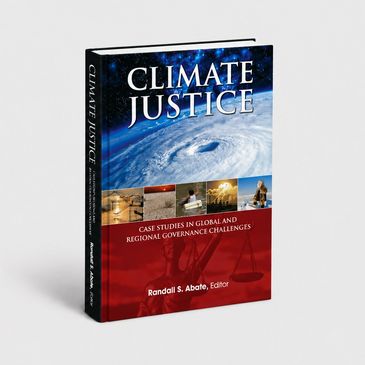
Book titled Climate Justice with a hurricane image.

Climate Justice: Case Studies in Global and Regional Governance Challenges

What Can Animal Law Learn From Environmental Law? Second Edition

What Can Animal Law Learn From Environmental Law? Second Edition

Climate change is one of the most complex political, social, and environmental issues of this century, and climate change adaptation has become an increasingly large focus of global efforts. The international community’s attention on adaptation has been primarily focused on developing countries’ needs, with consensus that the world’s most

Climate change is one of the most complex political, social, and environmental issues of this century, and climate change adaptation has become an increasingly large focus of global efforts. The international community’s attention on adaptation has been primarily focused on developing countries’ needs, with consensus that the world’s most vulnerable communities—the urban and rural poor, low-lying island nations, and indigenous peoples—require additional protection. It was in response to this need for equity that “climate justice” emerged.Climate Justice: Case Studies in Global and Regional Governance Challenges provides an overview of the landscape of climate justice from a variety of legal and geographic perspectives in a case study format. Drawing on the expertise of 29 contributors from 16 countries, the book analyzes climate justice from an international law perspective and from the perspectives of legal responses to promote climate justice in several regions of the world, including Pacific island nations, South Asia, North America, Africa, and the Middle East. It addresses proposed solutions to a range of regulatory obstacles under international law, U.S. law, and foreign domestic law in seeking to promote climate justice on a global scale.

Buy the Book

Climate Change Impacts on Ocean and Coastal Law: U.S. and International Perspectives

Climate Change Impacts on Ocean and Coastal Law: U.S. and International Perspectives

Climate Change Impacts on Ocean and Coastal Law: U.S. and International Perspectives

Ocean and coastal law has grown rapidly in the past three decades as a specialty area within natural resources law and environmental law. The protection of oceans has received increased attention in the past decade because of sea-level rise, ocean acidification, the global overfishing crisis, widespread depletion of marine biodiversity su

Ocean and coastal law has grown rapidly in the past three decades as a specialty area within natural resources law and environmental law. The protection of oceans has received increased attention in the past decade because of sea-level rise, ocean acidification, the global overfishing crisis, widespread depletion of marine biodiversity such as marine mammals and coral reefs, and marine pollution. Paralleling the growth of ocean and coastal law, climate change regulation has emerged as a focus of international environmental diplomacy, and has gained increased attention in the wake of disturbing and abrupt climate change related impacts throughout the world that have profound implications for ocean and coastal regulation and marine resources.

Climate Change Impacts on Ocean and Coastal Law effectively unites these two worlds. It raises important questions about whether and how ocean and coastal law will respond to the regulatory challenges that climate change presents to resources in the oceans and coasts of the U.S. and the world. This comprehensive work assembles the insights of global experts from academia and major NGOs (e.g., Center for International Environmental Law, Ocean Conservancy, and Environmental Law Institute) to address regulatory challenges from the perspectives of U.S. law, foreign domestic law, and international law.

Buy the Book

Climate Change and Indigenous Peoples The Search for Legal Remedies

Climate Change Impacts on Ocean and Coastal Law: U.S. and International Perspectives

Climate Change Impacts on Ocean and Coastal Law: U.S. and International Perspectives

Indigenous peoples occupy a unique niche within the climate justice movement, as many indigenous communities live subsistence lifestyles that are severely disrupted by the effects of climate change. Additionally, in many parts of the world, domestic law is applied differently to indigenous peoples than it is to their non-indigenous peers,

Indigenous peoples occupy a unique niche within the climate justice movement, as many indigenous communities live subsistence lifestyles that are severely disrupted by the effects of climate change. Additionally, in many parts of the world, domestic law is applied differently to indigenous peoples than it is to their non-indigenous peers, further complicating the quest for legal remedies. The contributors to this book bring a range of expert legal perspectives to this complex discussion, offering both a comprehensive explanation of climate change-related problems faced by indigenous communities and a breakdown of various real world attempts to devise workable legal solutions. Regions covered include North and South America (Brazil, Canada, the US and the Arctic), the Pacific Islands (Fiji, Tuvalu and the Federated States of Micronesia), Australia and New Zealand, Asia (China and Nepal) and Africa (Kenya).

Buy the Book

Book Chapters

Standing, in Cambridge Handbook on Climate Litigation (Cambridge University Press 2025)


The chapter explores the intricacies of the legal principle of standing, its role in climate litigation, and how it impacts the ability of parties to bring climate change-related lawsuits to trial. The author discusses interpretations of standing across different jurisdictions, such as the United States, New Zealand, and countries in Europe, and explains how these interpretations can either impede or facilitate climate litigation. He distills emerging best practice from this analysis, providing an insightful guide for future climate lawsuits. The author then identifies emerging best practice in interpreting standing rules in a flexible manner, thus allowing a broader range of actors to bring climate-related lawsuits and enhancing access to justice.


Climate Change Communication in Kolkata: Applying Communication Theories to Address Climate Change Displacement (with Lisha Samuel) in  Climate Change and Risk in South and Southeast Asia: Sociopolitical Perspectives (Routledge, 2022)


Atmospheric Trust Litigation in the United States: Pipe Dream or Pipeline to Justice for Future Generations?, in Climate Justice: Case Studies in Global and Regional Governance Challenges (ELI Press 2016)


Climate Change Impacts on Ocean and Coastal Law: Scientific Realities and Legal Responses (with Dr. Sarah Krejci) in Climate Change Impacts on Ocean and Coastal Law: U.S. and International Perspectives (Oxford University Press 2015)


Ocean Iron Fertilization: Science, Law and Uncertainty, in Climate Change Geoengineering: Philosophical Perspectives, Legal Issues, and Governance Frameworks (Cambridge University Press 2013)


Law Journal Articles

Greening the Forum: International Arbitration as a Pathway for Enforcing ESG in Climate Adaptation Commitments in Latin America, 58 Cornell Int’l L.J. 171 (202) (co-authored with Carla Noriega) (lead article)


As climate change vulnerability challenges in Latin America become more urgent, the enforcement of environmental, social, and governance (ESG) obligations—particularly those related to climate adaptation—is an emerging issue in arbitration in investor-State dispute settlement (ISDS). This article explores how arbitral tribunals are addressing ESG-related claims involving climate adaptation obligations in Latin America, assessing the extent to which climate adaptation measures are enforceable in ISDS frameworks. Following the introduction, Part I describes the applicable international and domestic climate change law frameworks and addresses contractual obligations that foreign investors have for ESG and climate adaptation in these projects. Part II addresses case studies in Peru, Colombia, and Ecuador to illustrate the tension between protecting investors’ interests and the State’s authority to enforce climate adaptation measures. Part III explores procedural challenges in ESG arbitration that threaten to limit the effectiveness of arbitration in the ISDS context. Part IV proposes substantive and procedural reforms to promote arbitration as a viable mechanism for enforcing climate adaptation standards in Latin America while balancing investor rights and public policy objectives.


Putting Lipstick on a Pig: Biogas, Methane Digesters, and the Greenwashing Playbook, 54 Env’t L. 545 (2024)


Industrial animal agriculture pitches biogas and methane digesters as solutions to the outsized methane footprint of concentrated animal feeding operations (CAFOs), yet these efforts merely seek to convey to the public that CAFOs’ operations are environmentally responsible. In reality, quite the opposite is true because biogas and methane digesters more deeply entrench these facilities into the status quo of unsustainable production and disposal methods at CAFOs. This article first describes industrial animal agriculture’s impacts on climate change, with a focus on methane emissions. It then addresses biogas and methane digesters as ineffective solutions to the methane emissions from CAFOs. Next, it examines how these misleading and inadequate responses in the industrial animal agriculture context parallel the fossil fuel industry’s greenwashing campaigns with blue hydrogen and carbon capture and storage facilities. The article proposes long-term and short-term accountability mechanisms to promote the phaseout of biogas and methane digesters in CAFOs. Effective long-term measures would involve implementing disclosure and verification standards much like those that are starting to be implemented in the fossil fuel industry context. These legislative efforts take time, however, and have not yet been implemented in the United States. In the meantime, an effective short-term response would be to pursue strategic litigation to raise awareness of and apply pressure to phase out these harmful measures by drawing on best practices from greenwashing lawsuits in the fossil fuel context. 


Enhancing Protection of “Climate Refugees” in Destination Hubs: A Comparative Analysis of Legal Mechanisms and Governance Challenges in the U.S. and India, 37 Harv. Hum. Rts. J. 293 (2024) (co-authored with Chhaya Bhardwaj)


The plight of climate refugees is a global crisis that requires global cooperation and regional responses. The United States and India are important regional destination countries for climate refugees. “Climate refugees” are not recognized as a category of people entitled to protection in either country; however, legal mechanisms in both countries can be applied to cross-border displacement due to climate change. Part I of the article introduces the challenge of defining the term “climate refugees.” Part II addresses legal mechanisms in India that can be used to protect people displaced across the border as refugees or protected persons, and Part III reviews these mechanisms in the United States. Part IV evaluates what the United States and India can learn from best practices in climate migration legislation in Europe and international human rights law. It also explores what these two countries can learn from each other’s best practices in developing governance frameworks for climate refugees. 


Coastal Migration With Dignity: Safeguards for Vulnerable Communities Disproportionately Burdened by Sea Level Rise Impacts, 54 Env’t L. Rep. 10744 (2024) (co-authored with Aashini Choksi)


This article proposes to apply social justice-oriented safeguards to diminish the vulnerability of communities in two climate migration case studies in the United States. First, it describes the troubling realities of “climate gentrification” in Florida as well as forced displacement from coastal areas for native communities in Alaska. It then addresses the existing federal and state legal frameworks in these contexts, and how gaps in each framework exacerbate the vulnerability of these overburdened communities. The article proposes law reforms to address these concerns. It first recommends adjustments to the Federal Emergency Management Agency’s (FEMA’s) authority that can help limit these vulnerabilities. It then addresses adaptive legal mechanisms in Florida to limit the burdens of climate gentrification on vulnerable communities. Finally, it proposes vulnerability assessments and funding mechanisms to protect Native Alaskan communities that need to be relocated away from coastal areas to safer inland destinations. The article concludes with broader reflections on the role of “receiving communities” as an emerging strategy to help displaced communities from coastal areas find a new place to call home.


Litigation to Protect the Marine Environment: Parallels and Synergies with Climate Litigation, 47 Wm. & Mary Env’t L. & Pol’y Rev. 595 (2023) (co-authored with Nadine Nadow and Hayley Dorrian-Bak) (lead article)


The world’s oceans are in crisis. Climate change impacts, biodiversity loss, plastic pollution, fisheries collapse, impacts to marine mammals, and vessel-based pollution are among the many threats the marine environment faces today. Fish biomass is predicted to drop by 3% to 25% by the end of the century due to climate change. Worse still, the amount of plastic in the world’s aquatic ecosystems is on track to hit 23 to 37 million tons per year by 2040. This Article reviews recent successes and obstacles in using litigation as a tool to address these concerns across several contexts in the marine environment. It surveys developments at the international, national, and subnational levels. The Article offers lessons from creative climate litigation strategies as a way to enhance litigation to protect the marine environment. It also recommends ways in which the ocean-climate nexus can provide mutual benefits in advancing the agendas of climate change regulation and ocean stewardship. Link


“Fool Me Once, Shame on You”: Promoting Corporate Accountability for the Human Rights Impacts of Climate Washing, 18 Intercultural Hum. Rts. L. Rev. 1 (2023) (lead article)


Effective climate change governance faces two overarching challenges. The first is mobilizing the political will to regulate climate change with sufficient ambition. Second, when regulatory measures are in place to address climate change, the next challenge is ensuring that governmental and private sector entities are on track to comply with these time-sensitive climate governance commitments. This article addresses the second challenge. It reviews “climate washing” litigation that seeks to hold fossil fuel companies and other private sector entities accountable for misleading the public about their compliance with climate change mandates or goals. The article argues that climate washing tactics threaten human rights to health, property, food and water, and life, especially in vulnerable communities, by postponing effective climate regulation and thereby amplifying the risks from climate change-related events such as severe storms, flooding, heat, and droughts. It proposes to incorporate human rights compliance mechanisms into companies’ characterizations of their climate change compliance to help ensure these entities are transparent and truthful in their efforts to comply with climate change governance mandates or goals.


Youth and Indigenous Voices in Climate Justice: Leveraging Best Practices from U.S. and Canadian Litigation, 45 Public Land & Resources L. Rev. 77 (2022) (lead article)


This article describes the evolution of youth and Indigenous climate justice litigation in the U.S. and Canada. It offers three recommendations to advance youth and Indigenous climate justice litigation in each country: (1) adjusting the type and scope of relief sought; (2) coupling the claims with rights-based arguments targeting laws at the federal and provincial levels in Canada and at the state level in the U.S.; and (3) capitalizing on the intersectionality between youth and Indigenous community claims. 


Anthropocene Accountability Litigation: Confronting Common Enemies to Promote a Just Transition, 46 Colum. J. Env’t L. 225 (2021) (climate change symposium issue)


This article offers a new perspective in the quest for climate justice. Myriad accountability lawsuits in the U.S. have been filed against the fossil fuel and industrial animal agriculture industries in the past few years, but these efforts have proceeded without coordination between the environmental and animal law fields. There has been no scholarly inquiry that unites the efforts to seek relief from “common enemies” for exacerbating the climate change crisis while profiting from their operations. The article first reviews the climate change impacts from the fossil fuel and industrial animal agriculture industries and examines how federal regulatory gaps and subsidies enable and exacerbate the climate change impacts from these industries. It then reviews legal theories in common law accountability litigation against these industries that seek damages for the harms these industries cause to public health and welfare, the environment, and animals. The article proposes that accountability litigation against the fossil fuel and industrial animal agriculture industries can facilitate a transition away from reliance on fossil fuels and factory farms to more sustainable alternatives. Positive outcomes from several related contexts including tobacco litigation, the phaseout of harmful substances in environmental regulation, and the COVID-19 crisis support the urgent need for this “just transition.” 


Atmospheric Trust Litigation: Foundation for a Constitutional Right to a Stable Climate System?, 10 Geo. Wash. J. Energy & Env’t. L. 33 (2019) (invited symposium submission) 


From Inside the Cage to Outside the Box: Natural Resources as a Platform for Nonhuman Animal Personhood in the U.S. and Australia, 5 Global J. Animal L. 54 (2017) (co-authored with Jonathan Crowe)


Banning Metal Mining in Guatemala, 40 Vt. L. Rev. 597 (2016) (co-authored with Raquel Aldana)


Ocean Iron Fertilization and Indigenous Peoples’ Right to Food: Leveraging International and Domestic Law Protections to Enhance Access to Salmon in the Pacific Northwest, 20 UCLA J. Int’l L. & Foreign Aff. 45 (2016)


Comment on Maxine Burkett’s Rehabilitation: A Proposal for a Climate Compensation Mechanism for Small Island States, 13 Santa Clara J. Int’l L. 125 (2015)


Corporate Responsibility and Climate Justice: A Proposal for a Polluter-Financed Relocation Fund for Federally Recognized Tribes Imperiled by Climate Change, 25 Fordham Env’t L. Rev. 10 (2013) (lead article, symposium issue)


International and Domestic Law Dimensions of Climate Justice for Arctic Indigenous Peoples, 43 U. Ottawa L.J. 113 (2013) (invited symposium submission) (co-authored with Elizabeth Kronk Warner)


Commonality Among Unique Indigenous Communities: An Introduction to Climate Change and its Impacts on Indigenous Peoples, 26 Tul. Env’t L. J. 179 (2013) (co-authored with Elizabeth Kronk Warner) (lead article in special issue on climate change and indigenous peoples)


A Tale of Two Carbon Sinks: Can Forest Carbon Management Serve as a Framework to Implement Ocean Iron Fertilization as a Climate Change Treaty Compliance Mechanism?, 1 Seattle J. Env’t L. 1 (2011) (lead article of inaugural issue)


NEPA, National Security, and Ocean Noise: The Past, Present, and Future of Regulating the Impact of Navy Sonar on Marine Mammals, 14 J. Int’l Wildlife L. & Pol’y 326 (2010)


REDD, White, and Blue: Is Proposed U.S. Climate Legislation Adequate to Promote a Global Carbon Credits System for Avoided Deforestation in a Post-Kyoto Regime?, 19 Tul. J. Int’l & Comp. L. 95 (2010) (invited symposium submission)


Public Nuisance Suits for the Climate Justice Movement: The Right Thing and the Right Time, 85 Wash. L. Rev. 197 (2010) (lead article, symposium issue)


Sowing Seeds Uncertain: Ocean Iron Fertilization, Climate Change, and the International Environmental Law Framework, 27 Pace Env’t L. Rev. 555 (2010) (co-authored with Andrew B. Greenlee)


A Green Solution to Climate Change: The Hybrid Approach to Crediting Reductions in Tropical Deforestation, 20 Duke Env’t L. & Pol’y F. 87 (2009) (co-authored with Todd A. Wright)


Marine Protected Areas as a Mechanism to Promote Marine Mammal Conservation: International and Comparative Law Lessons for the United States, 88 Or. L. Rev. 255 (2009)


Massachusetts v. EPA and the Future of Environmental Standing in Climate Change Litigation and Beyond, 33 Wm. & Mary Env’t L. & Pol’y Rev. 121 (2008) (invited)


Automobile Emissions and Climate Change Impacts: Employing Public Nuisance Doctrine as Part of a “Global Warming Solution” in California, 40 Conn. L. Rev. 591 (2008) (lead article)


Climate Change, the United States, and the Impacts of Arctic Melting: A Case Study in the Need for Enforceable International Environmental Rights, 26A Stan. Env’t L.J. 3 (2007) (lead article)


Kyoto or Not, Here We Come: The Promise and Perils of the Piecemeal Approach to Climate Change Regulation in the United States, 15 Cornell J.L. & Pub. Pol’y 369 (2006)


Dawn of a New Era in the Extraterritorial Application of U.S. Environmental Statutes: A Proposal for an Integrated Judicial Standard Based on the Continuum of Context, 31 Colum. J. Env’t L. 87 (2006) 


Pesticides and Water Don’t Mix: Addressing the Need to Close a Regulatory Gap Between FIFRA and the CWA, 35 Env’t L. Rep. 10055 (2005) (co-authored with Matthew T. Stanger)


It’s All About What You Know: The Specific Intent Standard Should Govern Knowing Violations of the Clean Water Act, 9 N.Y.U. Env’t L.J. 304 (2001) (co-authored with Dayna E. Mancuso)


The Biosafety Protocol and The World Trade Organization: Can the Two Coexist?, 12 Pace Int’l L. Rev. 107 (2000) (with Gretchen L. Gaston)


Rethinking Citizen Suits for Past Violations of Federal Environmental Laws: Recommendations for the Next Decade of Applying the Gwaltney Standard, 16 Temp. Env’t. L. & Tech. J. 1 (1997) (lead article)


Constitutional Limitations on Anticompetitive State and Local Solid Waste Management Schemes: A New Frontier in Environmental Regulation, 14 Yale J. on Reg. 165 (1997) (co-authored with Mark E. Bennett)


Sovereign Immunity and Citizen Enforcement of Federal Environmental Laws: A Proposal for a New Synthesis, 15 Va. Env’t L.J. 1 (1995) (co-authored with Carolyn H. Cogswell) (lead article)


Broadening the Scope of Environmental Standing: Procedural and Informational Injury-in-Fact After Lujan v. Defenders of Wildlife, 12 UCLA J. Env’t. L. & Pol'y 345 (1994) (co-authored with Michael J. Myers)


Copyright © 2026 Randall S. Abate - All Rights Reserved.

This website uses cookies.

We use cookies to analyze website traffic and optimize your website experience. By accepting our use of cookies, your data will be aggregated with all other user data.

Accept